RSE: España 0 – Europa 6
For English, click here
La semana pasada Forética publicó su informe de recopilación de los diferentes planes nacionales de RSE que existen en Europa, comparando lo que se hace en países referentes, como Alemania, Suecia, Noruega u Holanda, con lo que se hace en España. En Diario Responsable pueden encontrar un resumen/artículo sobre el contenido del informe.
En España hace algunos años que se creó el Consejo Estatal de Responsabilidad Social de las Empresas (CERSE), pero no existe un plan nacional como los que existen en Alemania o Suecia. Tengo que ser muy crítico con el CERSE ya que el balance es completamente insatisfactorio si lo comparamos con los avances hechos en otros países. El hecho de que el CERSE no esté llevando la batuta tiene como consecuencia que surjan iniciativas públicas y/o privadas que, si bien son loables y muy acertadas, adolecen de cierta descoordinación.
Después de leer el informe de Forética y las sugerencias que en él se hacen, y siendo también conocedor de las estrategias existentes en los diferentes países europeos, me permito hacer las recomendaciones siguientes a los que están llamados a perfilar el plan español de RSE, tan esperado y necesario:
- Avanzar en la confección de un catálogo estatal de buenas prácticas en RSE, con especial hincapié en aquellas que han generado valor tangible. El CERSE debería inventariar todas estas buenas prácticas y ponerlas a la disposición de todas las empresas y grupos de interés. También deberían recopilarse todas las iniciativas, tanto locales como autonómicas o estatales, en materia de promoción de la RSE y la sostenibilidad empresarial.
- Facilitar e intensificar el acompañamiento de aquellas empresas que deciden ser sostenibles a lo largo de todo del proceso. Ello puede hacerse de dos maneras:
- Una de ellas es promover la cooperación entre grandes empresas y pymes, abundando en la línea de promocionar la sostenibilidad a lo largo de toda la cadena de suministro. Ya hay iniciativas que trabajan en este ámbito, como el programa Transparencia, auspiciado por e marco Global Reporting Initiative, y en el que grandes empresas actúan como tutoras de empresas más pequeñas (generalmente sus clientes).
- Otra forma es continuar y extender programas como la iniciativa RSE-Pyme, en la que decenas de pymes de todo el país son acompañadas a lo largo de todo el proceso de implantación de uns estrategia de sostenibilidad empresarial.
- Las administraciones públicas pueden ser protagonistas ellas mismas de diferentes líneas de acción
- Promoción de la publicación de memorias de sostenibilidad por parte de ministerios y organismos públicos, e incorporación efectiva de criterios responsables en sus compras y licitaciones públicas.
- Además, a través de un programa de incentivos y premios a la innovación, se debería hacer hincapié en la competitividad como la principal ventaja de la RSE para las pymes.
- Educar e informar a la ciudadanía en materia de consumo responsable y gestión sostenible de la empresa. Un sistema de premios y bonificaciones a las empresas podrían hacer más visible a aquellas empresas socialmente responsables.
- Crear foros de encuentro entre grupos de interés, de manera que las administraciones, sobre todo las locales, actúen como puente de comunicación entre las empresas y sus grupos de interés.
- Por último y como medida realmente importante, facilitar y preparar el paso a un nuevo modelo económico más sostenible y de alto valor añadido que aproveche las oportunidades que ofrece la economía verde y la economía social, ofreciendo un sistema de incentivos y de ayudas a las start-ups. No podemos olvidarnos de que la sostenibilidad es el otro lado de la moneda de la RSE, y que un futuro Plan Nacional de RSE debe servir para sentar las bases de una economía más sostenible.
CSR: What SMEs Need
June 12th and 13th in Berlin. Block your diaries these days for the first international conference called “Networking for Better Corporate Social Responsibility Advice for Small and Medium Sized Enterprises”, to which I have the honor to be invited, along with other 99 CSR consultants. This conference, funded by the European Commission, will be a forum for experts from all over Europe, specialized in sustainability in small and medium enterprises (SMEs). There will be discussions about how to provide better advice to European SME’s, and how we can contribute to better sustainability strategies in European SMEs.
CSR consultants are already sharing views via social media more and more often. However, it’s what SMEs do in terms of sustainability what is missed. Most often it’s big corporation language.
Consultants can act as a bridge between SMEs, exchanging experiences, know-how and points of view. This is the only way that”small” CSR best practices will be known not only in small, local circles, but also in wider platforms where they can be used by other organizations. A networking event like this has many challenges to face:
- Spread the news about CSR best practices in SMEs. Usually it is bigger corporations’ programs the only ones that get in the picture, leaving aside useful learnings and experiences made by smaller companies. The path towards sustainability for a SME can have completely different challenges and motivations. Very often what is good for a MNC is not necessarily good for a SME.
- Create a “best practices database” where both SMEs and consultants can contribute and profit from. Unfortunately, very often brilliant initiatives with great benefits have a limited audience. They should be accessible through this platform.
- European CSR needs to happen at smaller scale, or it won’t happen at all. According to the European Commission, “SMEs provide two out of three of the private sector jobs and contribute to more than half of the total value-added created by businesses in the EU”. European CSR programs have to take this into account if they really want to succeed. SMEs need an environment where they feel comfortable and free to discuss how they manage their CSR and sustainability strategies. This conference should be this ideal environment.
- Share, optimize, improve existing initiatives. For instance, there are dozens of self-diagnose tools that remain known only to few people and companies, mainly because they are local initiatives, or because they don’t have the proper forum where they can be analyzed and discussed. These initiatives should be shared, compared and complemented in order to avoid duplicities and create synergies.
- Find the best ways to help smaller companies become part of a sustainable supply chain. In some cases sustainability comes top-down: First, multinational companies decide to adopt a sustainable strategy and, later on, they demand the same from their suppliers (often SMEs). Small and medium businesses need to be prepared for that.
- Simplify things for SMEs: Speak their language, use their scale, be one of them.
- Turn CSR benefits into real value. Explain CSR to SMEs by using examples that bring added value to their activities. Don’t be abstract, get specific, talk about value creation.
- The conference should definitely go beyond consultant networking and facilitate networking between SMEs as well.
- Help companies find new businesses opportunities that are hidden behind the curtain. Tear this curtain down and help SMEs discover a whole new world of green, sustainable activities.
- The conference should prepare the shift from an economy based of the production of stuff to a new model based on added value and more services.This applies as well on SMEs.
Stay in tune, I will keep you posted!
Sustainability And Growth, Are They Compatible?
Last week I attended the annual conference of the ESADE Institute for Social Innovation, which this year was about the connection between innovation and sustainability.
There were different workshops, one of them being about the concept of “Creating Shared Value“. This was the one I attended, reaffirming my conviction that CSR and Sustainability are compehensive concepts that go far beyond Porter and Kramer’s “big idea”. But CSV is not the topic of this post.
A question popped several times during the conference, and it remained unsolved on and on. It is a question that I, as CSR consultant, will often have to face from companies and training attendants:
Are growth and sustainability compatible? Do we actually have to “de-grow” in order to be sustainable? As CSR experts we need to have an answer to this interesting, fundamental question.
Yes, they are compatible. Personally I think that, apart from the fact that we shouldn’t confuse growth with prosperity or development, there are certain conditions that allow growth, ensuring a fair distribution and without putting our planet in danger:
- Let’s concentrate on producing less stuff, as Gil Friend already pointed in his book “The Truth About Green Business”. The production of more and more stuff is consuming our natural resources until total depletion.
- Let’s focus on producing more added value and more services connected to already exisiting goods. Goods should be designed in a way that they can easily be adapted to the latest technology, without having to launch a new product again and again.
- When it comes to competitive advantage, the stress is on resource efficiency, rather than on the pursue of everlasting growth. It’s how a company manages its costs and how it uses its resources what will make the differentiation from its competitors.
And finally, some questions:
- Is it realistic to expect that companies should grow year after year?
- Shouldn’t the focus be on the profitability of firms, rather than on their growth rates?
- Are we ready to accept that, in a scenario of finite resources of finite market demand, the only way for companies to grow is through mergers that will lead, sooner or later, to a monopolistic market?
Less stuff, more value.
CSR: New Business Opportunities Through Social Commitment
The recession is hitting Spain very hard. We are reaching an unemployment rate of almost 25% and many small businesses have to close.
However, there is room for good news and hope too. In Barcelona, several bars and shops located in the district of Raval have started a very nice initiative to offer products and services to unemployed people at lower prices ,with discounts of up to 50%. This initiative takes place on Tuesdays, a traditionally quiet, slow day for business.
These small bars and shops are showing social engagement and, at the same time, they have found a new business opportunity. They are not only attracting customers on a slow day like Tuesdays, they are also revitalizing the neighborhood with their promotion: the street is also more visited the rest of the week. At the end of the day, everybody benefits from it: the businesses, the unemployed people and the neighborhood.
This is a very good example of how SMEs can benefit from CSR in terms of the generation of new business opportunities. Pure shared value creation. Business With Common Sense.
CSR: A Survival Tool For SMEs
CSR is a survival tool for small and medium enterprises (SME).
With 20% votes, this is the main result from the poll that I published some weeks ago, and also my humble personal opinion. The rest of participants voted for options that could actually be considered as benefits that lead to the main one, namely:
- 18% think that CSR make smaller businesses more suitable to be part of the supply chain of conscious clients. As Jill Poet states, supply chain issues are becoming more and more important, and it is the way how sustainability can spread top-down, from bigger clients to smaller suppliers. CSR even opens the door to public contracts, especially now that the EU is emphasizing on sustainable criteria for public procurement.
- 14% voted that a sustainable strategy allows to optimise the use of resources, such as energy, etc. Here I would not only include energy costs but also transportation costs, logistics or office material.
- Also 14% think that CSR is a way to differentiate from competitors, and in uncertain times like these, where competition is rough and SMEs have to struggle every day, CSR can be the added value that is required to excel.
Intentionally, I didn’t include philanthropy, donations or any kind of sponsoring so maybe the poll was a little biased. Now I am curious about what would have been the result if I had included these options, which personally I do not consider a proper sustainability strategy.
However, I am surprised to see that the option connected with CSR as a self-knowledge tool (CSR to manage risks) was not picked by more participants, only 10% voted for it. Maybe because CSR as introspective analysis is more useful for complex structures, such as bigger corporations?
Last but not least, it was a little discouraging to see that CSR as gate to new products and services only got 6% of the votes. Are we really aware of the fact that sustainability can actually allow a company to reshape its portofolio? All kind of companies, not only SMEs, can develop sustainable goods addressed to certain market niches unexplored before. This is something we need to stress since I think it is an important benefit from CSR for SMEs.
I have to agree that CSR is the best strategy to survive in today’s changing world. and maybe it is so because of all the reasons stated above.
Thanks everyone for participating!
CSR: What’s In For Small Businesses?
Here are some prejudices concerning CSR/Sustainability and Small and Medium Enterprises (SME):
- Sustainability is for big companies
- Sustainability is too expensive
- Sustainability requires too many resources
- Sustainability is marketing, we cannot afford marketing campaigns
- We are far too few people, we don’t need social responsibility
These are some of the opinions I have to counterback when I explain sustainability to friends, relatives or even owners of small businesses. Most of them look at me skeptical and surprised. Their looks say “Small businesses have enough to do trying to survive in the current situation, they dont have time to think about social responsibility or sustainability”. However, the expression on their faces changes as soon as I start talking about the benefits of a sustainable strategy for a SME. SME are in fact open for CSR, as I explained in a previous post.
Which one is the most important benefit for a SME that engages in CSR/Sustainability? Take the poll!
Sustainability Trends In 2012: Predictions Or Wishful Thinking?
Dear CSR Gang, it’s that time of the year to make some predictions about the state of corporate sustainability and responsibility in 2012. Last week I read Susan McPherson’s ones and they inspired me to take out my crystal ball and see what it says about sustainability trends in the coming year. As you will see, most of the trends will be caused by the huge rise of social media. Here they are:
- Responsiveness of companies will need to be higher, faster. Through twitter, facebook and other social media, companies are more and more exposed to the public. Businesses need to respond to different demands, questions and complaints. They will learn to be fast if they dont want to make their customers angry and frustated. An example, Suchard was recently asked to guarantee that the chocolate they are using in their Spanish Christmas products does not come from children labor. It was a Friday evening and the company did not respond until later in the weekend. Their community manager was probably enjoying the weekend and had an unpleasant surprise when he/she discovered their facebook/twitter site full of messages from demanding customers. Suchard’s first reaction was to delete all messages from their wall, not very clever.
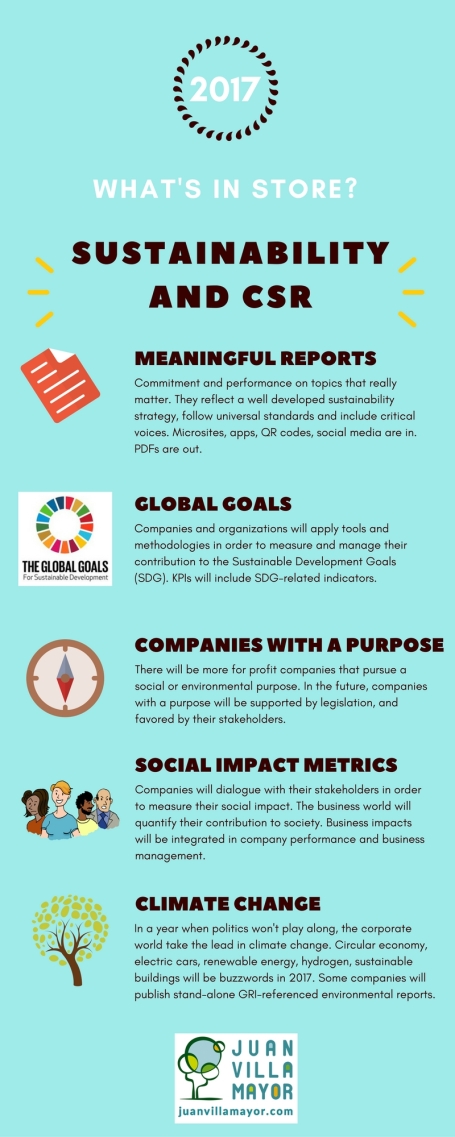
- The end of sustainability reporting (as we know it). This is a trend that has already been happening the last years. Printable or pdf-reports are the past. The present (and the future) are online sustainability reports that can be adapted or filtered according to the needs of each stakeholder group. They will be more interactive and will tend to be search engines rather than monolithic, inflexible documents. Probably you all know the impressive sustainability report of SAP, this could be a model of how a CSR report should look like in the future.
- Increasing role of companies as employability catalysators. Susan McPherson predicts a “continued growth in employee-engagement programs”. I would add that corporations will participate in programs to increase the employability of people at risk of social exclusion, such as minorities or long-term unemployed.
- The rise of a Pan-European CSR approach. The new European communication on CSR and its new definition will boost European initiatives. National frameworks will develop the European communication and this will certainly give a new, more efficient and coordinated approach.
- ISO 26000 will be the new keyword. Already recognised by the European communication on CSR as one of the “universal” frameworks, there will be pressures to make it a certification standard. It is certainly the most complete and universally recognised guide on CSR, for all kind of companies and organisations.
- Stronger relationships with stakeholders. The exposure of companies through social media will strengthen their relationships with their stakeholders. They will not only need to be more responsive, they will find new ways of stakeholder inclusion and innovative channels of dialogue.
- The growing importance of impact management as cornerstone of an efficient and genuine sustainability strategy. As the European Commission says, CSR is “the responsibility of enterprises for their impacts on society”.
- And finally, a set of questions rather than a trend. The rising expectations about Integrated Reporting. Will it be the new framework? Is it too much to handle? In an integrated report, will sustainability aspects be eclipsed by financial, economic figures? You might like to read Elaine Cohen’s take on Integrated Reporting, where she makes very good points about the subject.
Dear readers, I wish you merry Christmas/happy holidays and a successful, peaceful and sustainable new year 2012!
Some Tips On Stakeholder Inclusion
Last November I had the honor (and the pleasure) to participate at the very first GRI-certified training on stakeholder inclusion. It was conducted by Niels Ferdinand, director of BSD Consulting Spain, and it took place at the Madrid Chamber of Commerce.
As I wrote in my previous post, stakeholder mapping (and prioritisation) are very important steps on a company’s road towards sustainability. It gives a lot of insight, as well as orientation about which should be the points where a company needs to focus.
What is stakeholder inclusion? It’s the process by which you start a constructive dialogue with the groups affected by the impacts of your company. This process will lead to solutions concerning matters that are relevant for your company and your stakeholders, thus guaranteeing the sustainability of the enterprise in the future.
There are a couple of tips that you should follow if you want to have a fruitful dialogue with your stakeholders. The most important ones are:
- You should be very clear about the goals of the proccess. Also, you should be very clear about what will NOT be under any circumstance a matter of discussion. This has to be properly communicated to the stakeholders prior to starting the process. This is to avoid the rising of false (and potentially dangerous expectations) from the stakeholders.
- The way of dialogue will vary from stakeholder to stakeholder. Your company should decide on the best way for each stakeholder. Dialogue with customers will probably take place through social media, whereas inclusion of NGOs can happen at discussion rounds or joint projects (also depending on how deep the involvement desired from the stakeholders is).
- Do not forget to communicate always with your stakeholders, at the start, during and (most important) at the end of the process. It’s crucial that your stakeholders are informed at every stage, espcially at the end. Just imagine how frustrated your customers, your employees or local NGOs could be if they are not updated about the outcome of a process they have dedicated effort and resources to.
Stakeholder inclusion is a very valuable tool, but only if companies go along with the process till the very end: from first consults to communicating final results, otherwise, it’s just wasted time and resources. Clearness, honesty and communication are a must.
If you are interested in staleholder inclusion you might want to check the new AA1000SES standard on stakeholder inclusion that “provides a principles-based, open-source framework for quality stakeholder engagement and supports the AA1000APS Principle of Inclusivity. It can be used as a “stand-alone” standard, or as a mechanism to achieve the stakeholder requirements of other standards, including GRI G3 and ISO 26000″.
ISO 26000 Tips: First, Your Stakeholders
Where to start? Which steps should I take? How do I begin?
These are some of the questions that most companies, especially small and medium ones, pose themselves when they consider implementing a sustainability strategy. Of course, other questions will arise as well, especially related with costs and payback. However, doubts about how to start the process and which are the first steps that need be taken are some kind of existential doubt that always come up.
The guide ISO 26000 is a very useful tool for small and medium entreprises (SME) willing to commit themselves to corporate sustainability and responsibility. It offers a variety of hints on how to deploy the process.
One good piece of advice from the ISO 26000 is that a company should know who its stakeholders* are, as a first step prior to identifying relevant matters that need be addressed by the company.
*Basically, a stakeholder is everyone affected by the activities of our company: suppliers, employees, customers, shareholders, NGOs, the local community etc.
What is our reach? Which stakeholders are within this reach?
Identifying its stakeholders becomes the first milestone of a company’s way tos sustainability. Knowing who is affected by our impacts will let us know which issues need our special attention.
It requires a certain exercise of introspection by which we will analyse our internal and external relationships, as well as the impacts of our activities on others. This is a great self-knowledge tool that will not only help us set priorities, but also detect new business opportunities that might have been ignored so far.
How can we identify our stakeholders?
- We can check our activities by department, identifying each departemt’s stakeholders. For example, our purcahsing department has relationsips with suppliers, our sales department with customers and so on.
- We could also analyse our products life cycle, from product design to market launching and waste management, and considering as well those stakeholders affected at any point along the supply chain (maybe hidden in some remote place far away).
- You can also check how the company dealt with this issue in the past and build on that.
The advantage of stakeholder mapping as a step prior to implementing our sustainability strategy are the following:
- It is the best way to know where we are and whom we are playing with in our organisation.
- Identifying our stakeholders and being ready for their demands will open the gates to new business opportunities.
- Stakeholder mapping helps prioritise and focus on those groups of particular relevance for our organisation. After all, our resources are limited, especially if we are a SME, and we need to focus on the essential.
- Stakeholder analysis is the best way to avoid ignoring groups such as NGOs or communities that, even though they are not formal part of our organisation’s circles of action, are nevertheless affected by our activities.
Definitely, stakeholder mapping is one of the most valuable tips from the guide ISO 26000. It is probably the first step every company has to take on its roadmap towards corporate responsibility, right after having defined its strategy, and probably overlapping with other important steps, such as finding which issues are relevant to our company.
Europe settles it: CSR is an impact sport
It’s been one week since the European Commission published the new communication on CSR. I have read several interesting analysis and reactions*, and most of them welcome the declaration as a sign of the EU taking CSR “really seriously”.
The first thing that stroke me is that new document doesn’t highlight the voluntary approach as much as it did in 2002 and 2006. Furthermore, reading the communication the following concepts stand out:
- Impact: The European Commission defines CSR as “the responsibility of enterprises for their impacts on society”. A responsible company is the one that minimizes negative impacts and creates positive impacts on society. It is not what you produce or what you have to offer, but also all kind of impacts that your processes or operations may have on the environment or the community.
- Trust: Citizens and other stakeholders do not trust companies anymore as a result of the onging economic and financial crisis. Additional efforts are needed to restore trust through transparency and engagement. Companies are encouraged to find the way to translate this cry for transparency into credible strategies, avoiding greenwashing and consumer manipulation.
- Creation of shared value (CSV): The European Commission embraces this concept as a gate to new business opportunities. Innovative services and products will create value for both company and society, including an explicit mention of social business which didn’t exist in the previous communication of 2006.
- International standards: ISO 26000, Global Compact, OECD Principles are some of the recognised frameworks. The definition of what CSR means will no longer be left to what companies see fit. To the contrary, CSR will be defined by these international frameworks. Not everything can be called CSR any more.
Let’s put these keywords in a sentence:
“CSR deals with the impacts of enterprises on society in a way that it restores trust from all stakeholders, creates societal and company value and adheres to internationally recognised standards”
What’s your take? Is the new communication a move in the good direction? What does it mean for companies, especially small and medium enterprises?
*Here are other articles referring to the new communication:
- Allegro Ma Non Troppo, an interesting analysis by Helena Ancos (Spanish)
- Post by Tomás Conde, stressing the financial aspects of the new communication (Spanish)
- Post by David Connor, who calls the new communication “a pretty well balanced carrot and stick approach”


Comentarios recientes